
Desiccant vs refrigerant dehumidifiers: Which to choose?
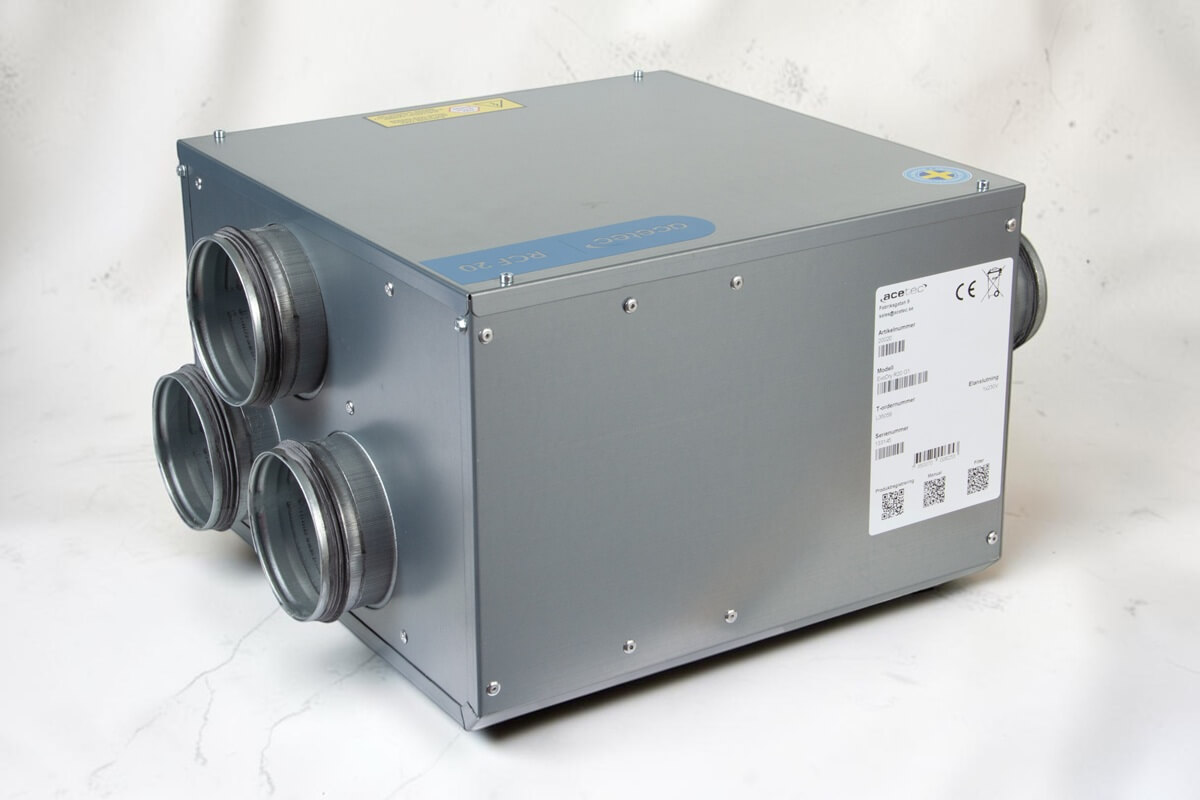
The difference between a desiccant dehumidifier and a refrigerant dehumidifier is how they remove moisture from the air. Desiccant dehumidifiers are often better suited to cold spaces such as crawl spaces, cold lofts and unheated storage rooms. Refrigerant dehumidifiers, also known as condensation dehumidifiers, are often a good choice for warmer rooms such as laundry rooms and heated basements. However, the deciding factors are the temperature, moisture load and performance of the specific model.
How does a desiccant dehumidifier work?
Air passes through a rotor containing a moisture-absorbing material that captures water vapour. A separate heated airflow then releases the moisture from the rotor. In our EvoDry dehumidifiers, this humid air is discharged through a wet-air duct, while drier air is returned to the space.
Because the process does not depend on water condensing on a cold surface inside the unit, the technology also works in cold conditions. For example, the EvoDry RCF 20 G1 has a specified operating range of −20 to +40 °C. However, the operating range does not mean that dehumidification capacity remains the same at every temperature.
Advantages and points to consider
- Suitable for cold spaces: A common choice for crawl spaces, cold lofts and unheated garages.
- No water tank in duct-connected EvoDry models: Moisture is discharged as humid air instead of collecting in a container.
- Correct installation is essential: The wet-air duct must be routed correctly, and the dry air must reach the entire space.
- Uses energy: Heat is used to regenerate the rotor, and energy consumption depends on the model and operating conditions.
How does a refrigerant dehumidifier work?
A refrigerant dehumidifier, also called a condensation dehumidifier, cools moist air as it passes over a cooling coil. As the air cools, water vapour condenses into liquid water, which collects in a tank or drains away. The air is then reheated before being returned to the room.
This technology is often used in heated basements, laundry rooms and other relatively warm spaces. At lower temperatures, dehumidification capacity usually decreases and frost may form on the cooling coil. Some models feature automatic defrosting and can also operate in cooler conditions. Check the model's stated operating range and capacity, rather than just whether it can start at a particular temperature.
Advantages and points to consider
- Often a good option for warm rooms: Condensation dehumidification can be energy-efficient when temperature and humidity are sufficiently high.
- Can be straightforward to position: Many freestanding models do not require a wet-air duct through an external wall.
- The water must be dealt with: Empty the tank or arrange a safe way to drain away the condensate.
- Capacity varies with temperature: Defrosting and lower air temperatures can affect how much water is removed.
Desiccant vs refrigerant dehumidifiers – comparison
| Feature | Desiccant dehumidifier | Refrigerant dehumidifier |
|---|---|---|
| How it works | Moisture is absorbed by a desiccant rotor. | Water condenses on a cooled surface. |
| Temperature | Often suitable for cold and unheated spaces. | Often better suited to warmer spaces. |
| Moisture removal | Humid air is discharged via a duct on EvoDry models with a wet-air connection. | Condensed water collects in a tank or drains away. |
| Installation | Requires correct air distribution and discharge of humid air. | Requires safe management of condensed water. |
| Energy and noise | Depend on the model, temperature, moisture load and operating mode. Compare the specifications. | |

The diagram is a simplified illustration of where the technologies are often used. It does not show an exact boundary that applies to every model. Base your decision on actual operating conditions and each product's capacity data.
Which dehumidifier should you choose for your space?
In a crawl space or cold loft, desiccant dehumidification is often relevant because temperatures can be low. Even so, start by finding and fixing any roof leaks, water ingress and other moisture sources. Read more about damp in crawl spaces.
In a garage or storage room, the choice depends partly on whether the space is heated and how much moisture is brought in, for example by wet vehicles. In a heated basement or laundry room, a refrigerant dehumidifier can be a good choice, while a cool basement may also benefit from desiccant technology.
See our guide to choosing the right dehumidifier for more examples.
How much does each type of dehumidifier cost to run?
Neither technology always uses less electricity than the other. Compare how much moisture the models can remove at your actual temperature and relative humidity, how much power they use and how many hours they are expected to run. A desiccant dehumidifier uses energy to regenerate its rotor. A refrigerant dehumidifier uses a compressor, among other components, and may need to defrost in cooler conditions.
Also factor in installation, any water drainage, filter replacements and ongoing maintenance. Neither desiccant nor refrigerant dehumidifiers are completely maintenance-free.
What to consider before installation
Do not choose a dehumidifier based on floor area alone. Air volume, temperature, air leakage, moisture load and air distribution all affect the capacity you need. See our guide to sizing a dehumidifier.
A desiccant dehumidifier normally requires a correctly installed wet-air duct, while a refrigerant dehumidifier needs a solution for the condensate. Always follow the installation instructions for the specific model. We can help you find the right EvoDry model and, if you wish, pass your installation enquiry to one of our partners.
