
How does a dehumidifier work?
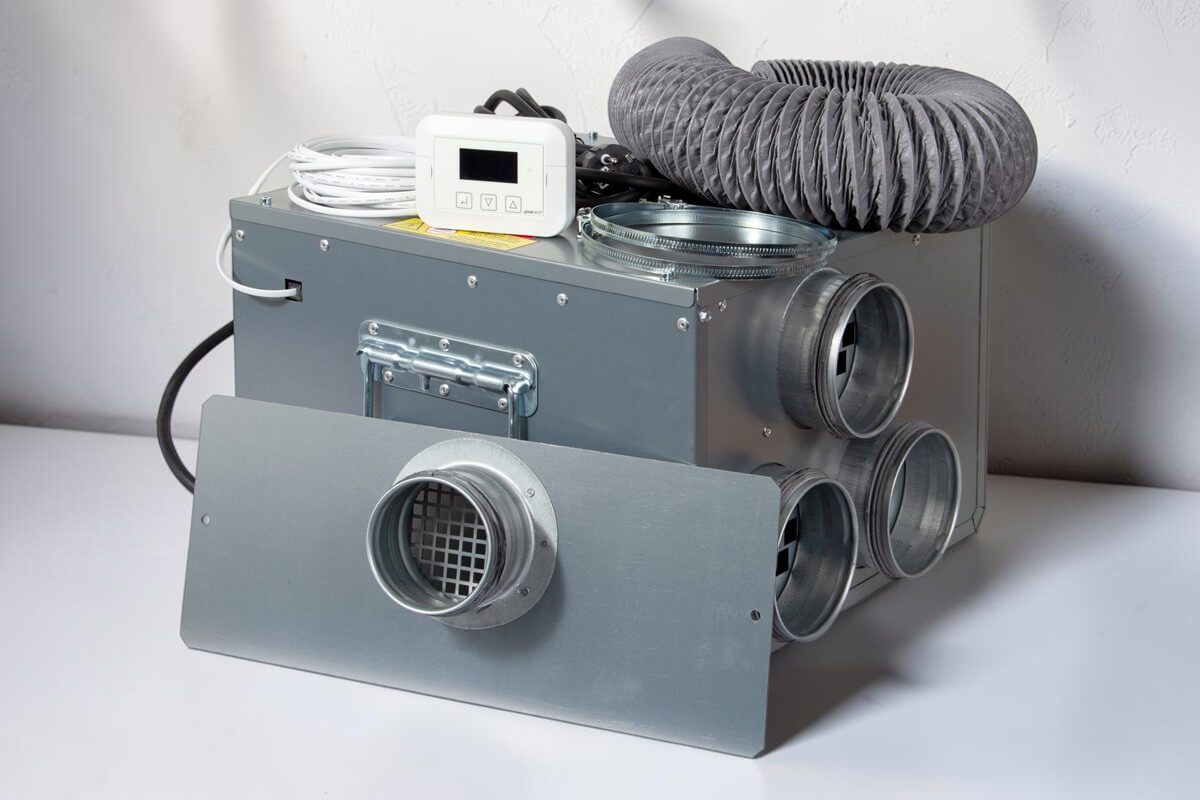
A dehumidifier reduces humidity by removing water vapour from the air. A condensation dehumidifier cools the air, causing moisture to turn into water that is collected or drained away. A desiccant dehumidifier instead captures moisture in a rotating material and removes it in a separate stream of humid exhaust air. The most suitable technology depends on the temperature, how much moisture enters the space and where the dehumidifier will be used.
What does a dehumidifier do to the air?
Air always contains a certain amount of water vapour. How humid it feels and the risk of condensation depend partly on the temperature. Relative humidity (RH) describes how close the air is to saturation at its current temperature.
A dehumidifier reduces the amount of water vapour in the air. This can help reduce the risk of condensation, musty odours and moisture-related problems in basements, laundry rooms, storage areas, crawl spaces and unheated attics. The risk of microbial growth in building materials cannot be determined from one RH reading alone; it also depends on the temperature, the material and how long the moisture remains.
How does a condensation dehumidifier work?
A condensation dehumidifier, also called a refrigerant dehumidifier, uses a refrigeration system to separate water from the air:
- Humid air is drawn in through an air inlet by a fan.
- The air is cooled at a cold evaporator. When it reaches its dew point, some of the water vapour condenses into droplets.
- The water is collected in a tank or discharged through a drain hose.
- The air is warmed again as it passes through the unit and is returned to the room with a lower moisture content.
This technology can be a good choice in a heated basement or laundry room, for example, where the temperature and moisture load provide favourable operating conditions. A portable unit can also be easy to move between rooms.
At lower temperatures, dehumidification capacity often decreases, and some models need to defrost their cooling coils. 15°C is not an absolute limit: instead, check the model's specified operating range and capacity at the temperature in your space. If the unit has a water tank, it must also be emptied unless continuous drainage is used.
How does a desiccant dehumidifier work?
A desiccant dehumidifier for crawl spaces and other cold areas uses a moisture-absorbing material rather than cooling the air. Acetec's EvoDry models remove moisture using a rotating desiccant rotor.
- Process air is drawn in. A fan directs the humid air through the dehumidifier.
- The rotor absorbs water vapour. The desiccant material captures moisture as the air passes through the rotor.
- Dry air is returned. The dehumidified air is returned to the space and can be distributed through ducts if several areas need to be reached.
- The rotor is regenerated. A separate heated airflow passes through part of the rotor and releases the moisture it has absorbed.
- Humid exhaust air is discharged. The humid regeneration air is discharged through a wet-air hose or duct. The rotor then continues the process for as long as dehumidification is needed.

| Term | What does it mean? |
|---|---|
| Process air | Air from the space that is drawn into the dehumidifier to be dried. |
| Dry air | Air that has passed through the dehumidification process and is returned to the space. |
| Wet air | The separate airflow that carries moisture released from the rotor and must be discharged outside. |
Because this technology does not rely on water vapour condensing on a cold cooling coil, desiccant dehumidifiers can also work well at low temperatures. They are therefore often used in moisture-prone crawl spaces, unheated attics, boats and unheated storage areas. However, dehumidification capacity and energy consumption also vary with climate and operating conditions.
In larger warehouses, industrial facilities and other commercial premises, similar technology is used in our professional desiccant dehumidifiers in the EvoDry Pro range.
Thermal and hygro-dynamic dehumidification – what's the difference?
Thermal dehumidification using heat
Heating a space lowers its relative humidity if the amount of water vapour stays unchanged. Heat does not, however, remove water vapour on its own. For the moisture to leave the space, it has to be carried away, for example through ventilation with air containing less moisture. Heating can also require considerable energy if the entire space must be kept warm.
Hygro-dynamic dehumidification with controlled ventilation
Hygro-dynamic systems work by exchanging air, often using fans controlled according to the conditions. This method can dry a space when the incoming air contains less moisture than the outgoing air. But comparing relative humidity alone is not enough: warm outdoor air can contain more water vapour than cool air even when its RH is lower.
This is particularly important in crawl spaces during spring and summer, when warm outdoor air can cool beneath the house and increase relative humidity. Air exchange is therefore not always the same as dehumidification. The Swedish National Board of Housing, Building and Planning describes this in its guidance on moisture from outdoor air in crawl spaces.
What is the difference between condensation and desiccant dehumidifiers?
| Feature | Condensation dehumidifier | Desiccant dehumidifier |
|---|---|---|
| How moisture is removed | Water vapour is cooled and turns into liquid water. | Moisture is absorbed by a rotor and discharged as wet air. |
| Typical applications | Heated areas, such as laundry rooms and basements. | Cold or intermittently unheated areas, such as crawl spaces and unheated attics. |
| Moisture discharge | Water tank or drain hose. | Wet-air hose or duct leading outdoors. |
| What to plan for | Operating temperature, defrosting and condensate drainage. | Air distribution, installation and safe discharge of wet air. |
Neither technology is best in every environment. Compare capacity and energy consumption at temperatures and humidity levels similar to the actual conditions in the space.
How does the humidistat control the dehumidifier?
A humidistat uses moisture measurements to control dehumidification according to a set value or another control principle. When the air is dry enough, dehumidification can be reduced or stopped; when humidity rises, it starts again. A hygrometer , on the other hand, displays measurements without necessarily controlling any equipment.
Acetec's EvoDry RCF 12 and EvoDry RCF 20 can use controls that take both temperature and relative humidity into account, including mould-index control. This allows dehumidification to be adjusted as the risk of moisture-related growth changes with temperature, rather than always relying on the same RH setting. However, the controls do not replace checks for building damage or incorrect installation.
What should you consider when choosing a dehumidifier?
- Identify where the moisture comes from. Repair water leaks and address issues such as rainwater ingress or ground moisture before sizing the dehumidification system.
- Check the temperature throughout the year. A cool crawl space has different conditions from a heated laundry room. Ideally, measure temperature and RH over several periods.
- Calculate the volume of the space and its moisture load. Floor area alone does not determine the capacity you need. Air leakage, wet materials and incoming moisture also affect demand.
- Plan how air and moisture will be transported. Dry air must reach the entire affected area. Condensate or wet air must also be discharged properly.
- Allow for controls and maintenance. Monitor operation and readings, keep air passages clear and replace filters according to the instructions for your model.
For permanently installed desiccant dehumidifiers in crawl spaces and unheated attics, positioning, sealing, dry-air ducts and wet-air discharge all need to be considered together. Read our guide to installing a desiccant dehumidifier before planning the work.
Remember: Dehumidification can reduce the moisture load and help prevent new problems, but it does not remove existing mould growth, repair rot or replace adequate ventilation where ventilation is required.
