
How much does a dehumidifier cost? Prices and installation
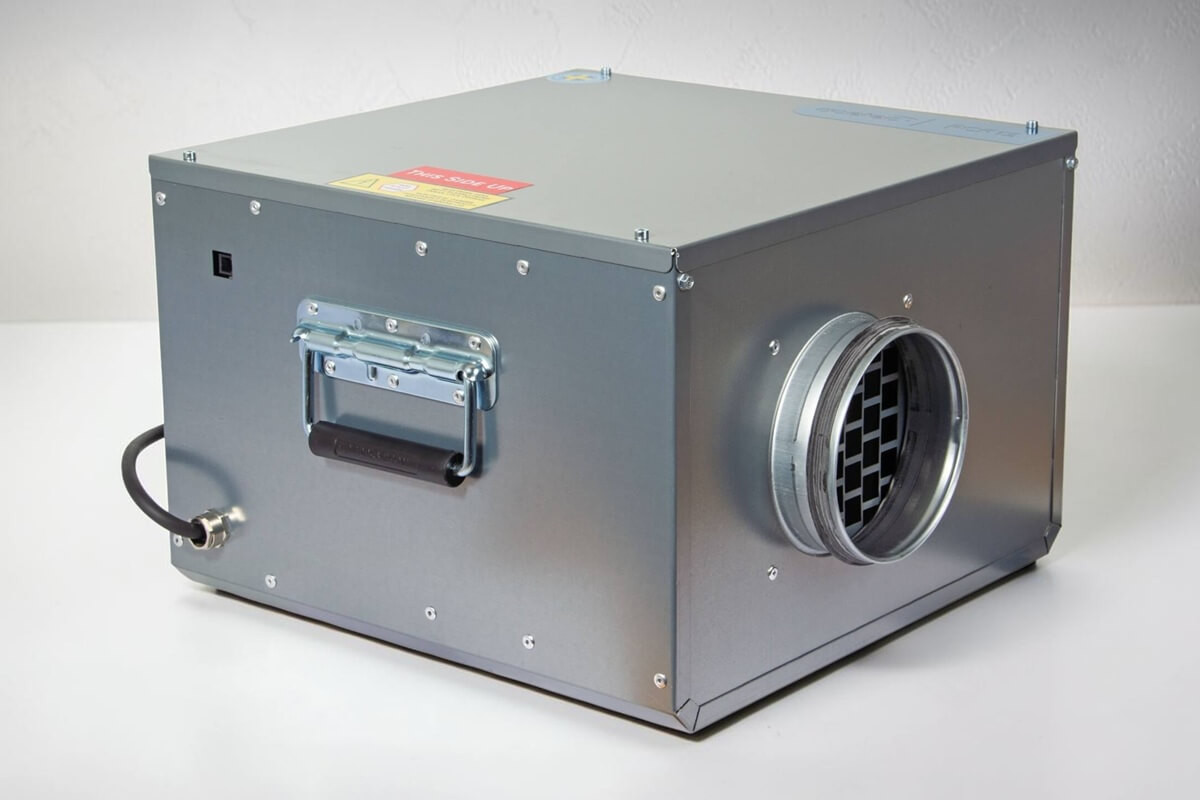
A dehumidifier can cost anything from a few thousand Swedish kronor to more than SEK 20,000 for a model designed for a crawl space or unheated attic. A permanently installed unit often involves additional labour, hoses, ducts and other materials. To make a fair comparison, you need to consider the unit price, installation cost and running costs. The price mainly depends on the technology, capacity, moisture load and conditions in the space.
Translation notice: This article is translated from Swedish and is based on information for the Swedish market. The prices in SEK, VAT, ROT tax deductions and installation examples refer to Sweden. Prices, regulations and tax relief may be different in other countries.
How much does a condensation dehumidifier cost?
A condensation dehumidifier, also known as a refrigerant dehumidifier, is often a cost-effective option for heated spaces such as basements, laundry rooms and storage rooms. It cools the air so that water vapour condenses into water, which collects in a tank or drains away. Many models are portable and do not require permanent ductwork.
A basic model may be sufficient for a small room. A larger space, or one with a high moisture load, needs greater capacity. These prices are approximate and include Swedish VAT:
| Condensation dehumidifier | Approximate price |
|---|---|
| Basic model | Approx. SEK 2,500–6,000 |
| Larger model | Approx. SEK 6,000–10,000 |
Condensation dehumidifiers often perform best in warmer spaces, for example where the temperature is normally above 15 °C. However, this is not a fixed temperature limit. At lower temperatures, capacity often decreases and some models need to defrost. Compare the model's performance at the actual temperature in your space.
Read more about the difference between condensation and desiccant dehumidifiers.
How much does a desiccant dehumidifier cost?
A desiccant dehumidifier can remove moisture even at low temperatures, making it a suitable choice for crawl spaces, unheated attics, boats and other unheated areas. A moisture-absorbing material in a rotor captures water vapour, which is then expelled as moist exhaust air through a hose or duct. You therefore do not need to empty a water tank, but the moist-air outlet must be planned properly.
The price depends on capacity, controls, control panel, accessories and how the air needs to be distributed around the space. A small boat has different needs from a large crawl space, and industrial facilities place further demands on the equipment. As a rough price guide, including Swedish VAT:
| Desiccant dehumidifier | Approximate price |
|---|---|
| Smaller model for a boat or storage room | Approx. SEK 4,000–13,000 |
| Model for a crawl space or unheated attic | Approx. SEK 13,000–25,000 |
| Industrial model (EvoDry Pro) | Varies according to capacity and configuration |
These ranges are indicative product prices, not quotations or fixed price lists. Installation and accessories may cost extra. See current prices for our dehumidifier models at the bottom of the article, where products are displayed automatically.
How much does a crawl-space dehumidifier cost?
A crawl-space dehumidifier for a typical detached house often costs around SEK 13,000–25,000 for the unit alone. This is an indicative product price; installation and any necessary work in the crawl space are additional. A larger or more moisture-prone crawl space may require a different capacity from a smaller, well-separated space.
Our EvoDry RCF models are designed for crawl spaces, among other applications. They can be controlled using both temperature and relative humidity and have a separate control panel, making it easier to monitor operation and conditions without entering the crawl space. Do not choose based on floor area alone: volume, ground moisture, air leakage and air distribution also matter.
Before investing in a crawl-space dehumidifier , you need to investigate the source of the moisture. Standing water, leaks and damaged building materials must be dealt with separately. Read more about moisture in crawl spaces and common remedial measures. You will find current model prices at the bottom of the page.
How much does an attic dehumidifier cost?
A dehumidifier for an unheated attic in a house is often in roughly the same price range as a crawl-space unit, around SEK 13,000–25,000 for the product. The final cost also depends on how the dehumidifier can be mounted, how dry air will be distributed and how moist exhaust air can be discharged outdoors.
In an unheated attic, moisture problems may be caused by warm indoor air leaking upwards, a roof leak or outdoor air contributing to high humidity. You therefore need to identify the cause and assess the construction first. A dehumidifier can help prevent ongoing moisture exposure, but it does not replace repairs or the remediation of existing damage.
Our EvoDry RCF models can adjust dehumidification according to both temperature and humidity. An easily accessible control panel is useful when the unit is installed in the attic. Also read our guide to moisture in attics before choosing a solution.
How much does dehumidifier installation cost?
Installation costs can vary greatly between different dehumidifiers and properties. The price is affected by access to the space, duct lengths, how moist exhaust air is discharged and whether ground sheeting or other preparations are needed. More extensive moisture damage may also require mould remediation or replacement of building materials.
When planning dehumidifier installation in a crawl space , the following work may need to be assessed and included in the quotation:
- Reviewing moisture sources, accessibility and the condition of the crawl space.
- Removing organic debris and, if needed, preparing ground moisture protection.
- Planning airtightness and ventilation to suit the crawl-space construction.
- Installing the dehumidifier and routing dry-air and moist-exhaust-air ducts.
- Positioning the control panel and carrying out any necessary electrical work.
- Checking operation and air distribution after installation.
Sealing vents or changing ventilation is not always the right measure and must be assessed in light of the crawl space's design. Ask the installer to specify what is included and what costs extra before comparing quotations.
Cost example: EvoDry RCF 20 G1 with installation
This example assumes an EvoDry RCF 20 G1 installed in a crawl space. We assume a labour cost of SEK 13,000 and an additional SEK 2,000 for materials, including Swedish VAT. These amounts are simplified assumptions, not standard prices. The current price of the dehumidifier itself is shown among the models at the bottom of the article.
| Cost item | Amount incl. VAT |
|---|---|
| EvoDry RCF 20 G1 | See current product price at the bottom |
| Installation, assumed labour cost | SEK 13,000 |
| Extra materials, assumed cost | SEK 2,000 |
| Total before any ROT tax deduction | Current model price + SEK 15,000 |
ROT example: If SEK 5,000 of the labour cost qualifies for Sweden's ROT tax deduction, a deduction of 30% gives a saving of SEK 1,500. ROT applies only to eligible work and not automatically to installation of the dehumidifier itself.
Can you claim a ROT tax deduction for installation?
ROT does not automatically apply to the entire installation labour cost. Under the Swedish Tax Agency's rules, work consisting solely of installing or servicing machinery does not normally qualify for this tax deduction. If the installation project also includes building work that qualifies for ROT, a deduction may in certain cases be available on the eligible share of labour costs. In Sweden, the deduction in 2026 is 30% of eligible labour costs, not of the dehumidifier, materials or other charges.
Ask the installer to specify which tasks, if any, qualify for ROT before factoring in a deduction.
Read more about ROT deductions for dehumidifier installations and check the conditions with the Swedish Tax Agency (Skatteverket).
Energy consumption – what affects running costs?
Electricity consumption is part of the total cost of owning a dehumidifier. It varies with the model, season, temperature, moisture load, how airtight the space is and how long the unit needs to run. It is therefore not possible to give a single electricity cost that applies to every home.
For a desiccant dehumidifier, you need to consider both fan operation and the energy used to regenerate the rotor. Demand-based control can reduce unnecessary dehumidification, for example by accounting for both temperature and relative humidity. A larger dehumidifier is not necessarily cheaper to run: correct sizing and installation matter more than simply choosing the highest possible capacity.
We develop our EvoDry dehumidifiers with energy-efficient operation in mind, including carefully designed construction, fans and heating elements suited to each unit's purpose. Several models use PTC heating elements, and our RCF models can adjust dehumidification based on both temperature and relative humidity. This can limit unnecessary operation, although actual energy use always depends on the moisture load and installation.
Filters and maintenance also affect the cost
Filters must be checked and replaced in accordance with the manufacturer's instructions. The frequency depends, among other things, on dust levels and operating conditions. For our EvoDry models, two filter changes per year are a useful starting point, but always follow the manual for your model. See our dehumidifier filters.
When comparing dehumidifier prices, it therefore makes sense to consider the complete solution: product, installation, materials, electricity, filters and any maintenance. Our current dehumidifier models and prices are displayed at the bottom of the article.
