
What can an air purifier remove?
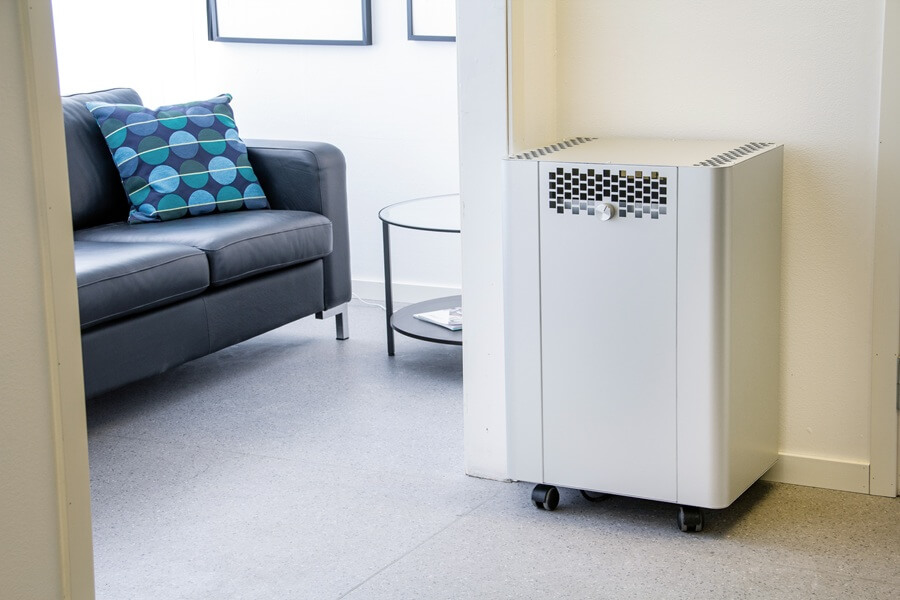
An air purifier can reduce airborne particles such as pollen, dust, mould spores and smoke particles. With the right filter, it can also capture tiny particles that carry viruses or bacteria. However, air purification does not replace ventilation, cleaning or action to remove the source of pollution.
What can an air purifier remove?
An air purifier draws in room air, passes it through filters and returns the filtered air to the room. How much pollution it removes depends on the filters, airflow and the pollutants present.
- Pollen and allergen-carrying particles: Filtration can reduce pollen and other allergen-carrying particles while they remain airborne.
- Dust and fine particles: An effective particle filter can also capture small particles from traffic, combustion and activities taking place in the building.
- Mould spores: Airborne spores can be filtered out, but an air purifier will not remove mould already growing on building materials.
- Smoke particles: Particle filters can reduce fine airborne particles from smoke. Gases in smoke need to be addressed separately.
- Particles carrying viruses and bacteria: HEPA filtration can reduce these particles in room air, but it cannot guarantee that infections will be prevented.
A filter only captures what passes through the purifier. Dust already settled on floors, furniture and other surfaces still needs to be removed by cleaning. Read more about air cleaners and airborne respiratory viruses.
Can an air purifier help with bad smells?
That depends on the source of the smell and the filters fitted. A HEPA filter captures particles, not gases. Our APU air purifiers also have an activated carbon filter that can reduce certain gaseous pollutants and odours. Results vary with the substance, its concentration and how long the filter has been in use.
If an odour comes from damp damage, a leak or an ongoing process, deal with the cause first. Air purification can help, but it does not replace adequate ventilation or local extraction at the source.
How filtration works in our APU air purifiers
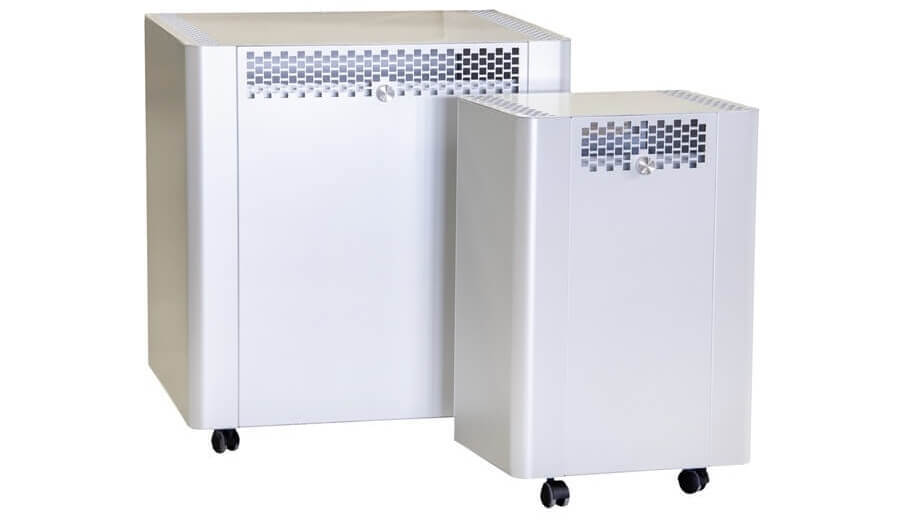
Our range includes APU air purifiers for small rooms and larger commercial spaces. They use three filtration stages to tackle different types of pollution:
- Pre-filter: Captures coarser dust and reduces the load on the other filters.
- Activated carbon filter: Can reduce certain gases and odours that a standard particle filter will not capture.
- HEPA H14 filter: Captures very small airborne particles with high filtration efficiency.
Our HEPA H14 filters are supplied by Swedish company Camfil and tested to EN 1822. Class H14 means a minimum removal efficiency of 99.995% at the particle size that is most difficult for the filter to capture. This figure describes the filter’s performance, not a guarantee that the whole room will be 99.995% particle-free. Read more about HEPA filter testing under EN 1822.
Where is an air purifier most useful?
Supplementary air purification is particularly useful in places where many people spend time, where particles are generated or where you want better filtration in a specific room.
- At home: In bedrooms or living rooms where you want to reduce airborne pollen, dust and other particles.
- Offices and shared spaces: In meeting rooms, reception areas and open-plan offices, local particle filtration can complement existing ventilation. Read more about air purifiers for offices.
- Industrial sites and warehouses: Air purification can reduce airborne dust, but it must work alongside local extraction and other protective measures wherever operations generate pollutants. Read more about air purifiers for industrial use.
How do you choose the right capacity?
Start with the room volume, how many particles enter or are generated in the space, and how freely air can circulate. A large open-plan area will generally need more airflow than a small enclosed room. Noise and positioning also affect how well a purifier works in daily use.
Our APU 500 provides airflow of up to 520 m³/h, while our APU 1700 provides up to 1,675 m³/h. As a simplified example, 520 m³/h equates to just over five room-volume passes per hour in a 100 m³ room at maximum airflow. That does not mean every part of the room is filtered evenly or that all particles disappear after an hour.
Position the air purifier so that its inlet and outlet are unobstructed. To maintain performance, inspect and replace filters according to their condition and the servicing instructions. You can find replacement filters for our APU air purifiers in our range.
What can an air purifier not replace?
A standalone air purifier recirculates indoor air. It does not supply the fresh outdoor air a building needs or remove carbon dioxide produced by occupants in the way that ventilation does. It cannot fix damp, remediate mould damage or replace local extraction for sanding dust and industrial emissions.
If a room feels stuffy or carbon dioxide levels are high, check the ventilation. In spaces with substantial particle emissions, control pollution at its source first. Read more about workplace ventilation and carbon dioxide monitoring from the UK Health and Safety Executive.
When should you ask for help choosing?
If your premises have several rooms, activities that change throughout the day or high dust levels, it can be difficult to decide how many air purifiers you need. We can help you assess airflow, positioning and filter choice based on how your space is used.
