
What is a crawl space? How this foundation works
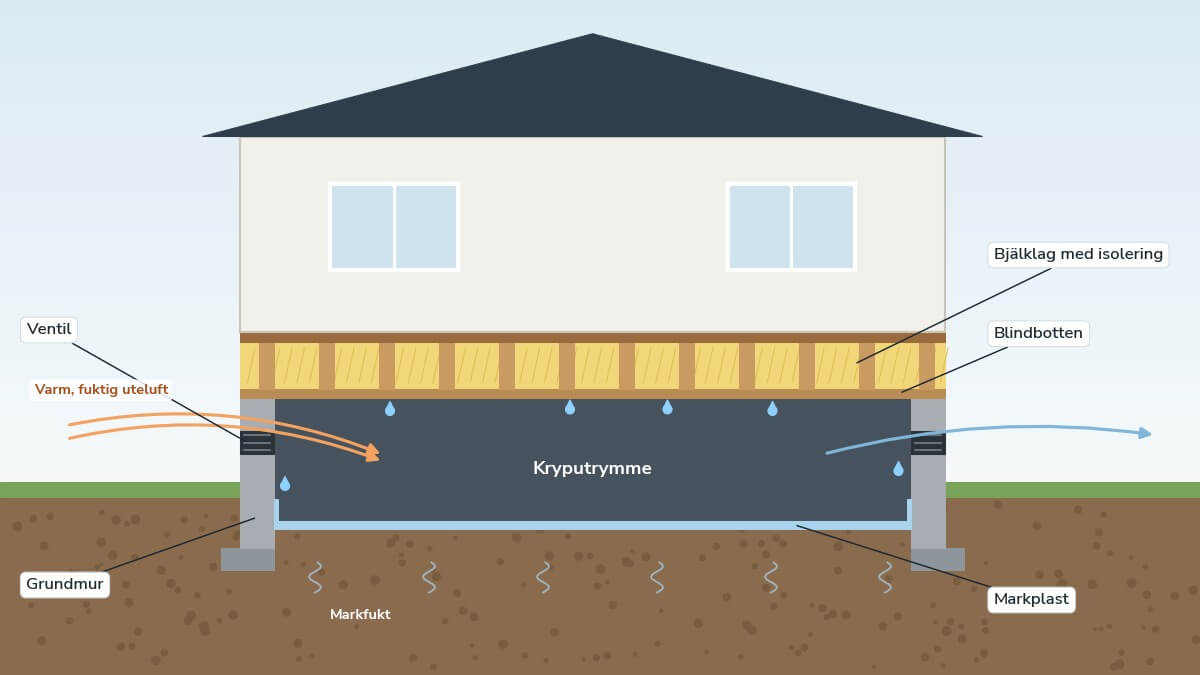
A crawl space is a type of foundation in which an air space separates the ground from the house’s floor structure. This space can make building services easier to access, but it also needs protection against moisture. Outdoor-air-ventilated crawl spaces in particular can develop high relative humidity when warm summer air cools beneath the house. It is therefore important to understand how the foundation is built, check its condition and deal with moisture sources before considering dehumidification.
What does a crawl space look like, and how does it work?
A crawl space usually consists of low foundation walls supporting the house’s floor structure. Between the ground and the floor is a space that is often reached through an inspection hatch, either from outside or inside the house. Its height varies considerably. Some crawl spaces are high enough to enter, while others are so low that they must be inspected by other means.
Above the crawl space is the floor structure, with insulation and an underside lining that holds the insulation in place. The ground may be soil, sand or another surface, sometimes covered with a barrier that reduces evaporation of ground moisture. Older crawl spaces do not necessarily have such protection.
Outdoor-air-ventilated crawl spaces, traditional Swedish crawl spaces and other designs
An outdoor-air-ventilated crawl space has openings that let in air from outside. The traditional Swedish torpargrund is an older form of crawl space, often built with stone or brick foundation walls. Other designs control ground moisture, foundation walls and airflow differently to reduce the risk of dampness.
How a foundation performs therefore depends not only on what it is called, but also on insulation, ventilation, ground conditions and any alterations made to the house.
If you live in an older house, you can read more about moisture in traditional Swedish crawl spaces.
What are the advantages of a crawl space?
One advantage is that water pipes and other services may be easier to reach than when they are embedded in a concrete slab. A crawl space may also suit plots where ground conditions and differences in elevation make this type of foundation appropriate. However, accessibility varies, and a crawl space is not automatically cheaper or easier to maintain than other foundation types.
The main challenge is moisture protection. The space is close to the ground, often has cold surfaces and may contain timber and other materials that can be damaged by prolonged exposure to moisture.
Why do crawl spaces develop moisture problems?
Warm summer air cools beneath the house
In spring and summer, the outdoor air warms up faster than the ground beneath the house. When warm, humid air enters a cool crawl space, its relative humidity rises. If a surface is cold enough, condensation may form on the foundation walls or the underside of the floor. This is why opening more vents can sometimes bring in more moisture rather than dry the space.
The Swedish National Board of Housing, Building and Planning (Boverket) explains this in its guidance on moisture from outdoor air in crawl spaces.
Ground moisture and water ingress
The ground naturally contains moisture that can evaporate into the crawl space. Rainwater, leaking downpipes, ground sloping towards the house and poor drainage can also make the ground beneath it wetter. Standing water must always be investigated and dealt with at its source; a dehumidifier cannot replace effective drainage.
Changes to insulation and temperature
If an older house receives additional insulation in its floor structure, less heat may escape down into the foundation. The crawl space can then become cooler and the relative humidity may rise. This does not mean that adding insulation is wrong, but moisture conditions should be assessed before the structure is altered.
How can you tell if your crawl space is damp?
A musty smell inside the house, especially near floors and inspection hatches, can be a clue. But an odour does not prove that mould is present, and damage can occur without any smell. During an inspection, look out for:
- Condensation, puddles or visibly damp ground.
- Discolouration and suspected microbial growth on the underside lining or floor joists.
- Timber that is soft, damaged or shows signs of rot.
- Repeated periods of high relative humidity over an extended time.
- Air leaks or odours entering the living area through hatches and service penetrations.
A hygrometer can help you monitor temperature and relative humidity over time. Ideally, measure in different seasons and at several locations if the crawl space is divided into sections. However, a hygrometer measures the air, not the moisture inside timber or other building materials. If you suspect damage, a qualified professional may need to carry out a building inspection.
See our guides to moisture in crawl spaces and mould in crawl spaces.
How to prevent and deal with moisture in a crawl space
Start by finding out where the moisture comes from. A useful approach is to carry out the checks in this order:
- Check drainage around the house. Inspect roof drainage, downpipes, ground slopes and any leaks. Find out why water is collecting near or beneath the foundation.
- Inspect the materials and ground. Look for organic debris, damp patches and suspected growth. A properly designed ground vapour barrier can reduce the amount of moisture evaporating into the space, but it must not trap standing water.
- Assess any damage. Materials affected by mould or rot may need remediation or replacement. Lowering the humidity will not remove existing damage.
- Assess ventilation and sealing. Do not open or close vents at random. Airflow, temperature and pressure differences between the crawl space and the home need to be assessed for your particular foundation.
- Monitor the conditions. Check that the problem does not return as the weather changes. If humidity remains high, controlled dehumidification may form part of the solution.
Inspect safely: Do not enter a confined crawl space if there is standing water near electrical installations, suspected structural weakness or other safety hazards. Ask a professional to inspect it instead.
When is a dehumidifier needed in a crawl space?
If the crawl space continues to have excessively high humidity for long periods after moisture sources and any damage have been addressed, dehumidification may be suitable. Our desiccant dehumidifiers for crawl spaces use a moisture-absorbing material in a rotor to remove water vapour from the air. The moisture is discharged through a duct as moist air, while drier air is returned to the crawl space. This technology also works at low temperatures.
The right model depends on the crawl space’s volume, temperature, moisture load and whether air can reach all parts of the space. Separate compartments may need dedicated dry-air distribution. A dehumidifier is no substitute for repairing leaks or removing existing microbial growth.
What is required to install a dehumidifier?
Installing an EvoDry RCF, for example, requires a coordinated plan: how ground moisture will be limited, which openings need sealing, where the dehumidifier will be positioned, how the moist air will be discharged and how dry air will be distributed. The control panel, filter access and electrical connection must also be suitable for the specific model.
There is no universal installation checklist that suits every crawl space or EvoDry model. Our RCF instructions state that installation must be carried out by a qualified person. Read our guide to installing a dehumidifier in a crawl space and always follow the latest manual for the exact model. This will help you choose a solution that suits the house’s construction, rather than just the dimensions of the dehumidifier.
