
What is a hygrometer? How to measure humidity
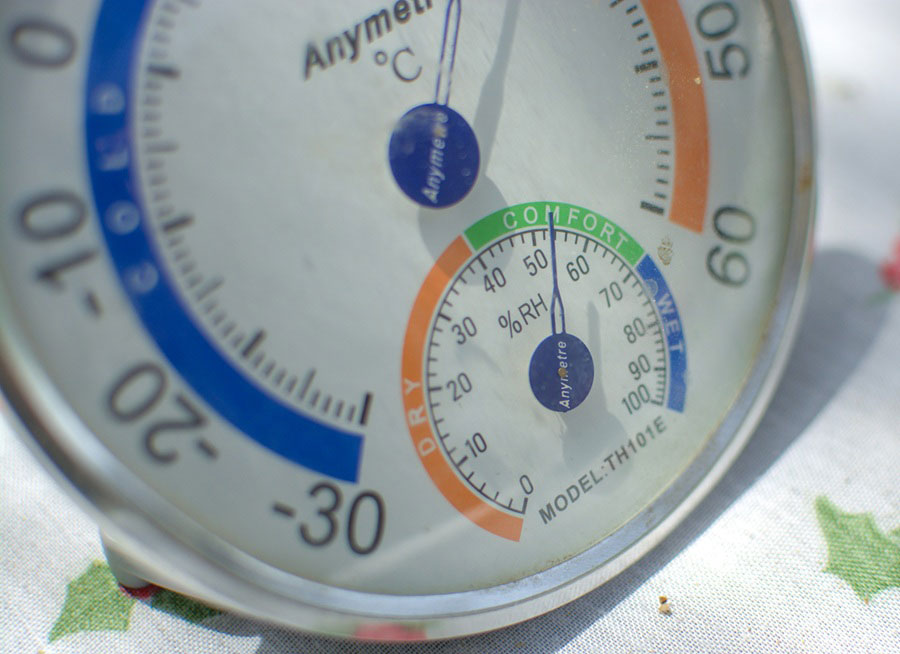
A hygrometer is an instrument that measures how humid the air is, usually expressed as relative humidity (RH) in percent. It helps you spot unusually humid or dry air and see how conditions change over time. However, a hygrometer measures the air around its sensor – not moisture inside walls, floors or roofs. You also need to know the temperature to interpret the reading.
What does a hygrometer measure?
Most hygrometers display relative humidity, abbreviated RH in English and RF in Swedish. The percentage indicates how much water vapour the air contains compared with saturation at its current temperature. At 100% RH, the air is saturated. If it cools, water vapour may then condense on a surface such as a window.
Temperature matters because RH can rise as the air cools, even without any additional water vapour. The same air can therefore have a higher RH when it enters a cool basement or crawl space. Read our explanation of what relative humidity means.
How does a hygrometer work?
Digital hygrometer
A digital hygrometer contains an electronic humidity sensor. In many models, the sensor’s electrical properties change as it absorbs or releases water vapour. The instrument converts that change into an RH reading displayed on a screen. Many models also show temperature, the highest and lowest readings recorded, or a measurement history.
A model that logs readings can be particularly useful if you want to find out whether humidity rises at night, after a shower or when the weather changes.
Analogue hygrometer
An analogue hygrometer usually has a pointer rather than a screen. Traditional hair hygrometers make use of the fact that hair changes length as humidity changes. Other mechanical versions use synthetic materials. An analogue model can be useful for a quick reading, but some require adjustment or calibration according to the manufacturer’s instructions.
SMHI, the Swedish Meteorological and Hydrological Institute, describes both electronic sensors and older measuring methods in its guide to how air humidity is measured.
Where is a hygrometer useful?
- At home: Track how humidity varies between bedrooms, living rooms and laundry rooms. Ideally, measure while the ventilation is operating as usual. If moisture from showering and cooking lingers, the air exchange may need attention. Find out more about our ventilation units if the ventilation system needs improving.
- In crawl spaces and cold attics: Check whether RH stays high for extended periods or changes with the seasons. Temperature and humidity should be monitored together. Read more about moisture in crawl spaces. If humidity remains too high after the moisture sources have been addressed, a crawl space dehumidifier may be a useful addition.
- In motorhomes, caravans or storage rooms: See whether the air remains humid during storage. Also check seals, condensation and possible water leaks.
- During renovation and drying: Monitor air humidity as a space dries out. Check the moisture content of the materials as well before painting or enclosing surfaces.
- In greenhouses, archives and hobby rooms: Monitor conditions where plants, paper, timber or other sensitive materials need a stable environment.
There is no single RH value that is ideal for every room and building material. The risk of moisture damage depends, among other things, on temperature, the material and how long it remains damp. Do not rely on a fixed percentage as your only basis for a decision.
How to use a hygrometer – five practical tips
- Choose a representative location. Place the instrument on a shelf or another open spot, away from direct sunlight, radiators, showers and open windows.
- Check the temperature at the same time. An RH reading without temperature does not tell the whole story, especially when comparing a warm room with a cold space.
- Allow the instrument to adjust. If you move it from a cold storeroom into a warm room, the sensor needs time to stabilise in the new environment.
- Look at the trend. Record readings over several days and compare them with rainfall, showering, cooking or airing the room. Recurring patterns tell you more than one reading.
- Check whether the readings make sense. If a value seems unreasonable or two instruments differ considerably, review their placement and the manufacturer’s guidance on accuracy and calibration.
What is the difference between a hygrometer and a moisture meter?
The terms are often confused, but the instruments answer different questions:
- Hygrometer: How humid is the air where the sensor is located?
- Material moisture meter: How much moisture is present in a particular material, such as wood or part of a building? The measuring method and interpretation depend on the material.
A hygrometer can show that the air in a room has high RH, but it cannot reveal a hidden leak behind a wall. And a normal humidity reading does not rule out moisture damage in a floor or floor structure. If you notice recurring condensation, damp patches, discolouration or a musty smell, the cause needs investigating. Our guide to signs of moisture damage explains what to look for.
